
Equb Savings Group: How Ethiopia's Rotating Savings Work
BY: DA PUBLISHED: 2026-11-27 20:25:22 | UPDATED: 2026-11-27 17:47:26 | Views: 56
Learn how an equb works, the pros and cons of joining one, and a simple checklist to join safely. General information only, not financial advice.
An equb is one of the best-known traditional ways to save in Ethiopia. A group of people agree to put in the same amount of money on a regular schedule, and each round one member receives the whole pot. Many families, coworkers and neighbors have used this approach for generations.
If you are new to the idea, or living abroad and curious how relatives save, this guide explains how an equb savings group works. You will also find its strengths, its limits and a practical checklist for joining one safely.
Key takeaways
- An equb is a rotating savings group: everyone contributes the same amount each round, and one member collects the pot.
- It works on trust and clear agreements, so rules should be settled before the first payment.
- It can build a saving habit, but it does not pay interest and it is not a bank account.
- Knowing the members and writing down the rules protects everyone.
- This article is general information only and is not financial advice.
What Is an Equb?
An equb is a group savings circle. Members agree on a fixed contribution and a schedule, such as weekly or monthly. At each meeting or payment date, the total collected goes to one member.
The cycle continues until every member has received the pot once. At that point the group can end, or members can agree to start a new cycle.
Equbs are popular because they are simple, social and flexible. Groups can be small or large, and the contribution can fit almost any budget.
How an Equb Round Works, Step by Step
Every group has its own style, but most follow a similar pattern.
- Form the group. A handful of people who know each other agree to take part.
- Set the contribution. Everyone pays the same amount each round.
- Choose the schedule. Decide how often payments are made and when the pot is handed over.
- Decide the order. Members agree on who receives the pot in each round.
- Collect and pay out. A coordinator collects the contributions and gives the pot to that round's recipient.
- Repeat until everyone has received once. The cycle then closes.
A simple example
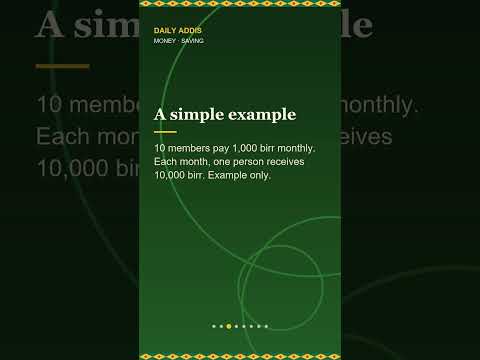
This is an illustration only. Imagine 10 members who each contribute 1,000 birr every month. Each month the pot is 10,000 birr, and one member receives it. After 10 months, everyone has paid in 10,000 birr and received 10,000 birr once.
The value is not extra money. It is a lump sum that arrives on a date you know in advance, which can help with planned goals.
How Groups Decide Who Receives the Pot
The order matters, because receiving the pot early feels like a short-term advance, while receiving it late feels like a savings goal. Groups commonly use one of these methods:
- Random draw: names are drawn at the start, and everyone can see the process.
- Agreed order: members discuss and agree on a sequence, sometimes based on planned needs.
- Fixed list: the order is set when members join and written down.
Whatever method is used, it should be clear, fair and recorded so nobody is surprised later.
Video 1 of 1
Benefits and Limits of an Equb
An equb suits some goals better than others. Here is a general comparison of three ways to set money aside.
| Feature | Equb group | Bank savings account | Cash at home |
|---|---|---|---|
| Builds a regular habit | Yes, social commitment | Yes, if you set it up | Depends on discipline |
| Lump sum on a known date | Yes | Only if you save toward it | Only if you save toward it |
| Earns interest | No | Often yes, rates vary | No |
| Formal protections | Usually limited to group trust | Provided by a licensed institution | None |
| Easy access | Only on your turn | Usually flexible | Immediate, but easy to spend |
The main strength is the habit and the accountability. The main limit is risk: if a member stops paying or the coordinator mismanages funds, there may be no formal way to recover money.
How to Join an Equb Safely
Because an equb depends on trust, a little preparation goes a long way. Use this checklist before you pay anything.
- Know the members. Join groups made up of people you know or who are well referred by someone you trust.
- Ask about the coordinator. Find out who holds the money and how they keep it safe.
- Get the rules in writing. Contribution, schedule, order, late-payment rules and what happens if someone leaves.
- Keep your own record. Note each payment you make, with the date and amount.
- Prefer traceable payments. Where possible, pay through licensed bank or mobile money channels so there is a record.
- Pick an amount you can manage. Missing payments creates stress for the whole group.
- Be cautious of unrealistic promises. A genuine equb returns what members put in. Anything promising extra profit deserves a closer look.
Making the Most of Your Payout
When your turn comes, a short plan helps the money last. These are general ideas, not professional advice:
- Decide in advance what the lump sum is for, such as a planned purchase, school costs or a repair.
- Set aside a portion for your emergency savings before spending the rest.
- Move the money to a safe, licensed account soon after you receive it rather than carrying cash.
- Remember that you still owe contributions in later rounds if you received early.
Common Mistakes to Avoid
- Joining without understanding the schedule or the total commitment.
- Relying on a verbal promise instead of a written agreement.
- Joining several groups at once and being unable to keep up.
- Treating an equb as a replacement for emergency savings.
- Handing cash over with no receipt or record.
Frequently Asked Questions
Is an equb the same as a bank savings account?
No. An equb is an informal group arrangement based on trust, while a savings account is offered by a licensed institution. They can complement each other, but they work differently.
Does an equb pay interest?
Generally no. Members receive back what the group collected, so the benefit is discipline and timing rather than growth.
What happens if someone stops paying?
This is why written rules matter. A good agreement explains how late or missed payments are handled and what happens to the rotation.
Can I join an equb from abroad?
Some groups include members in other countries. If you do, use licensed transfer channels, keep records of every payment and confirm the rules in writing with the group.
Conclusion
An equb can be a friendly and practical way to build a saving routine, especially when you know the people involved and agree on clear rules. Understanding how it works, and where its limits are, helps you decide whether it fits your goals.
Disclaimer: This article is for general information only and is not financial advice. Consider your own situation and speak with a qualified professional or a licensed financial institution before making financial decisions.
You May Also Like
Latest Videos
Stop Buying Apartments Blindly: 3 Hidden...
Jul 08, 2026Super Girl Movie 2026 is finally here!
Jul 05, 2026Ethiopian Kitfo
Jul 05, 2026Related Articles

How to Save Money on Groceries: 10 Pract...
1 week ago
How to Build an Emergency Fund: A Simple...
3 weeks ago