
Breathing Exercises for Stress Relief: A Simple Beginner Guide
BY: DA PUBLISHED: 2026-11-27 20:09:17 | UPDATED: 2026-11-27 17:47:26 | Views: 53
Learn four simple breathing exercises for everyday calm, with step-by-step instructions, a quick comparison table, and safety tips for beginners.
Busy mornings, long commutes, crowded markets and full inboxes can leave anyone feeling wound up. One of the easiest ways to take a short pause is also the one tool you always carry with you: your breath.
This guide walks you through four beginner-friendly breathing exercises for stress relief. They need no equipment, no special space and only a few minutes. They are general wellness habits, not medical treatment.
Key takeaways
- Slow, gentle breathing is a simple way to take a mindful pause during a busy day.
- Start with just two to five minutes and keep your breathing comfortable, never forced.
- Four easy techniques to try: belly breathing, longer exhale breathing, box breathing and the 5-5 rhythm.
- Pair breathing with a regular cue, such as your morning coffee or the end of your workday.
- Stop if you feel dizzy or uncomfortable, and consult a healthcare professional if you have any health concerns.
Why breathing is a good place to start
Many of us breathe quickly and shallowly without noticing, especially when we are rushing or concentrating hard. Slowing down on purpose gives your attention something steady to rest on. For many people, that small pause helps them feel calmer and more present.
Breathing exercises are also easy to fit into real life. You can do them at your desk, on a bench, in a parked car or before bed. There is nothing to buy and nothing to memorize.
Think of them as a daily habit for general wellbeing, similar to stretching or taking a short walk. They are not a cure for any condition, and they do not replace professional care.
Before you begin: set up for comfort
A little preparation makes practice more pleasant. You do not need a quiet room, but a calm corner helps when you are learning.
- Sit or lie comfortably. Keep your back fairly tall and your shoulders relaxed.
- Loosen tight clothing. Your belly should be free to move.
- Breathe through your nose if comfortable. If not, breathe in a way that feels natural to you.
- Keep it gentle. Your breath should feel easy, never strained.
- Start small. Two to five minutes is plenty at first.
Four simple breathing exercises to try
1. Belly breathing
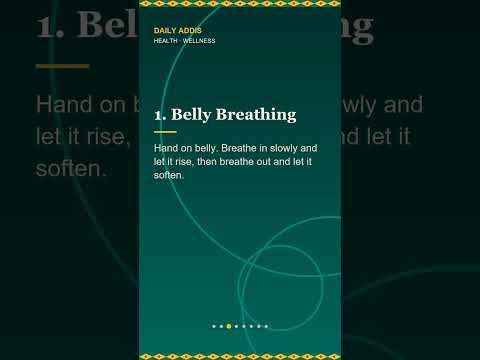
This is the best starting point for beginners. Place one hand on your chest and the other on your belly.
- Breathe in slowly through your nose and let your belly rise gently.
- Breathe out slowly and let your belly soften.
- Keep the hand on your chest as still as feels natural.
- Repeat for two to five minutes.
2. Longer exhale breathing
Here, your out-breath is a little longer than your in-breath. Many people find this rhythm especially soothing.
- Breathe in through your nose for a count of four.
- Breathe out slowly for a count of six.
- Repeat for about ten breaths, then breathe normally.
If a count of six feels too long, shorten both numbers. Comfort matters more than the count.
3. Box breathing
Box breathing uses four equal steps, like the four sides of a square. It gives a busy mind a simple pattern to follow.
- Breathe in for a count of four.
- Hold gently for a count of four.
- Breathe out for a count of four.
- Pause for a count of four, then repeat.
Skip the holds, or shorten them, if they feel uncomfortable. You can simply breathe in and out in a smooth rhythm instead.
Video 1 of 1
4. The 5-5 rhythm
This is the easiest pattern to remember. Breathe in for about five seconds and out for about five seconds, with no holds at all. It works well for a few minutes at the end of the day.
Which technique fits which moment?
Each exercise suits a slightly different situation. Use this table as a quick guide, and feel free to switch if one does not feel right.
| Technique | Pattern | Good for | Difficulty |
|---|---|---|---|
| Belly breathing | Slow in, slow out, belly moves | Learning the basics | Very easy |
| Longer exhale | In 4, out 6 | Winding down in the evening | Easy |
| Box breathing | In 4, hold 4, out 4, pause 4 | Focusing before a task | Moderate |
| 5-5 rhythm | In 5, out 5 | A calm daily routine | Easy |
How to make it a daily habit
Consistency matters more than length. A few minutes each day is easier to keep up than one long session once a week.
- Attach it to something you already do. Try it after brushing your teeth, while the kettle boils or before your first coffee.
- Set a gentle reminder. A phone alarm with a simple label such as "breathe" is enough.
- Use waiting time. Queues, traffic and waiting rooms are natural moments for a few slow breaths.
- Track it lightly. A tick on a calendar can keep you motivated without pressure.
- Combine it with other habits. Pair it with a short walk, a stretch or a regular sleep routine.
Common mistakes and safety notes
The most common mistake is trying too hard. Taking huge breaths or holding for too long can leave you feeling lightheaded. Smooth and easy is the goal.
- Do not force long breath holds, and stop if you feel dizzy, faint or uneasy.
- Return to normal breathing whenever you need to.
- Avoid practicing while driving, swimming or in any situation that needs your full attention.
- If you have a heart or lung condition, are pregnant, or have any health concerns, ask a healthcare professional before trying breath-holding techniques.
Please note: This article offers general wellness information only. It is not medical advice and is not meant to diagnose, treat or prevent any condition. Always consult a healthcare professional about your personal health needs. If stress or anxiety feels overwhelming or lasts a long time, please reach out to a qualified professional or someone you trust.
Frequently Asked Questions
How long should I practice each day?
Two to five minutes is a good start. Many people build up to ten minutes over time, but there is no required length. Short, regular sessions are perfectly fine.
When is the best time to do breathing exercises?
Any time that suits you. Some people like the morning to set a calm tone, while others prefer a short session in the evening. You can also use them during short breaks in the day.
Do I need to close my eyes?
No. Closing your eyes can help you focus, but you can also keep a soft gaze on a fixed spot. Choose whatever feels comfortable and safe.
What if my mind keeps wandering?
That is completely normal. When you notice your thoughts drifting, gently bring your attention back to the feeling of your breath. Each return is part of the practice.
Conclusion
Breathing exercises are a free, simple and flexible way to add a little calm to your day. Start with belly breathing, try the other patterns as you grow comfortable, and keep every session gentle.
Pick one moment tomorrow, perhaps with your morning coffee, and take five slow breaths. Small pauses add up, and as always, consult a healthcare professional if you have questions about your health.
You May Also Like
Latest Videos
Stop Buying Apartments Blindly: 3 Hidden...
Jul 08, 2026Super Girl Movie 2026 is finally here!
Jul 05, 2026Ethiopian Kitfo
Jul 05, 2026Related Articles

Eye Strain from Screens: Simple Daily Ha...
3 hours ago
Desk Posture Tips: Simple Habits and Str...
1 week ago